

A Landmark Year for WA at the 2026 AFL Open
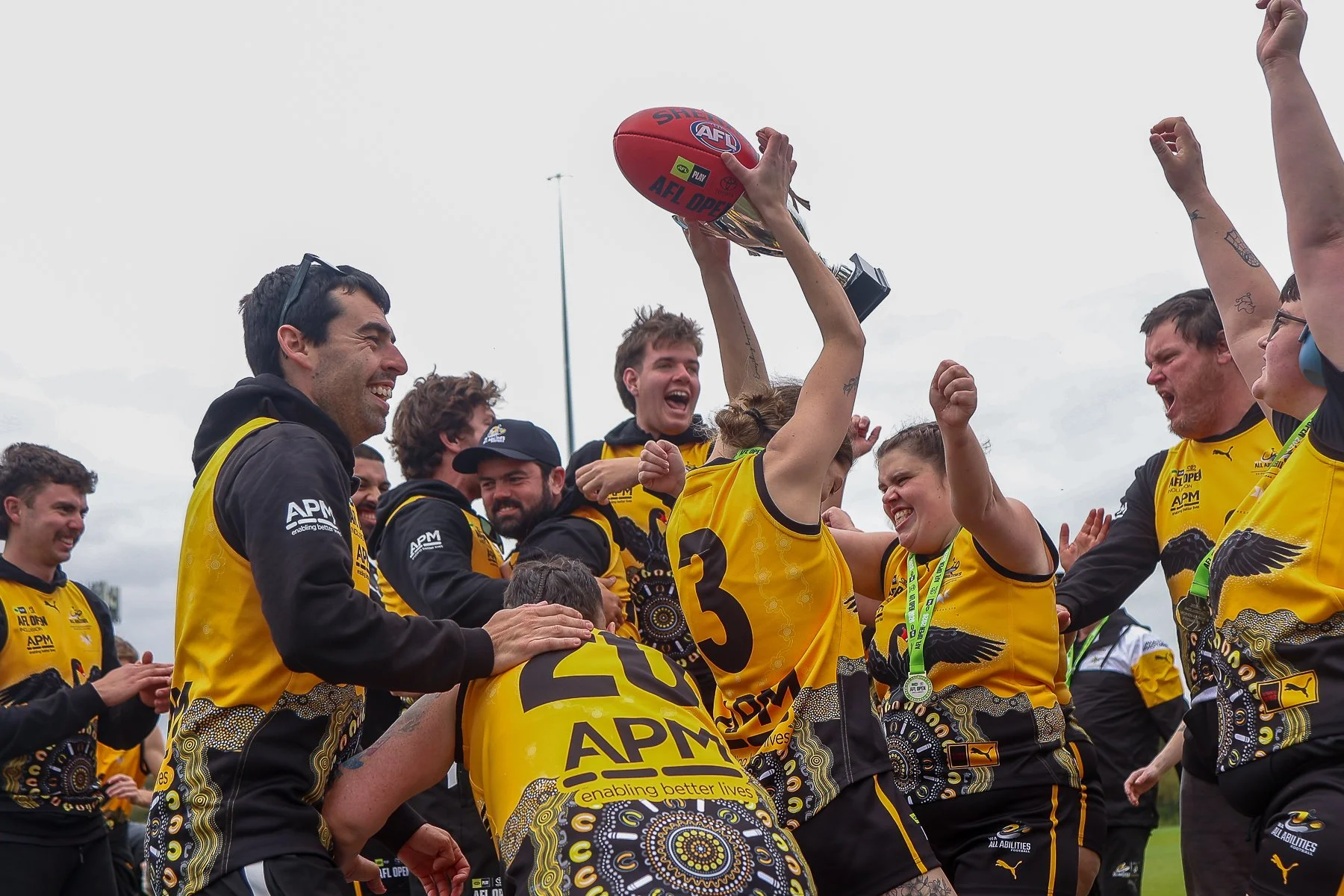
Player Abbey Partridge holding up the cup and game ball after the APM Women’s Inclusion team won the inaugural Women’s Inclusion Premiership, surrounded by the APM Men’s and Women’s inclusion teams.
Dylan Buckley - @thedilmaphotographer
Trying to wrap up the 2026 AFL Open in one article feels like an impossible task, with a mountain of milestones achieved at both football and personal levels. “How does one quantify what an incredible opportunity this has been for this team?” (A quote from a player’s mother.)
On Sunday, 11 October, 15 support staff and 40 players arrived at Perth Airport, Terminal 1, for a 7:30 am flight to Melbourne.
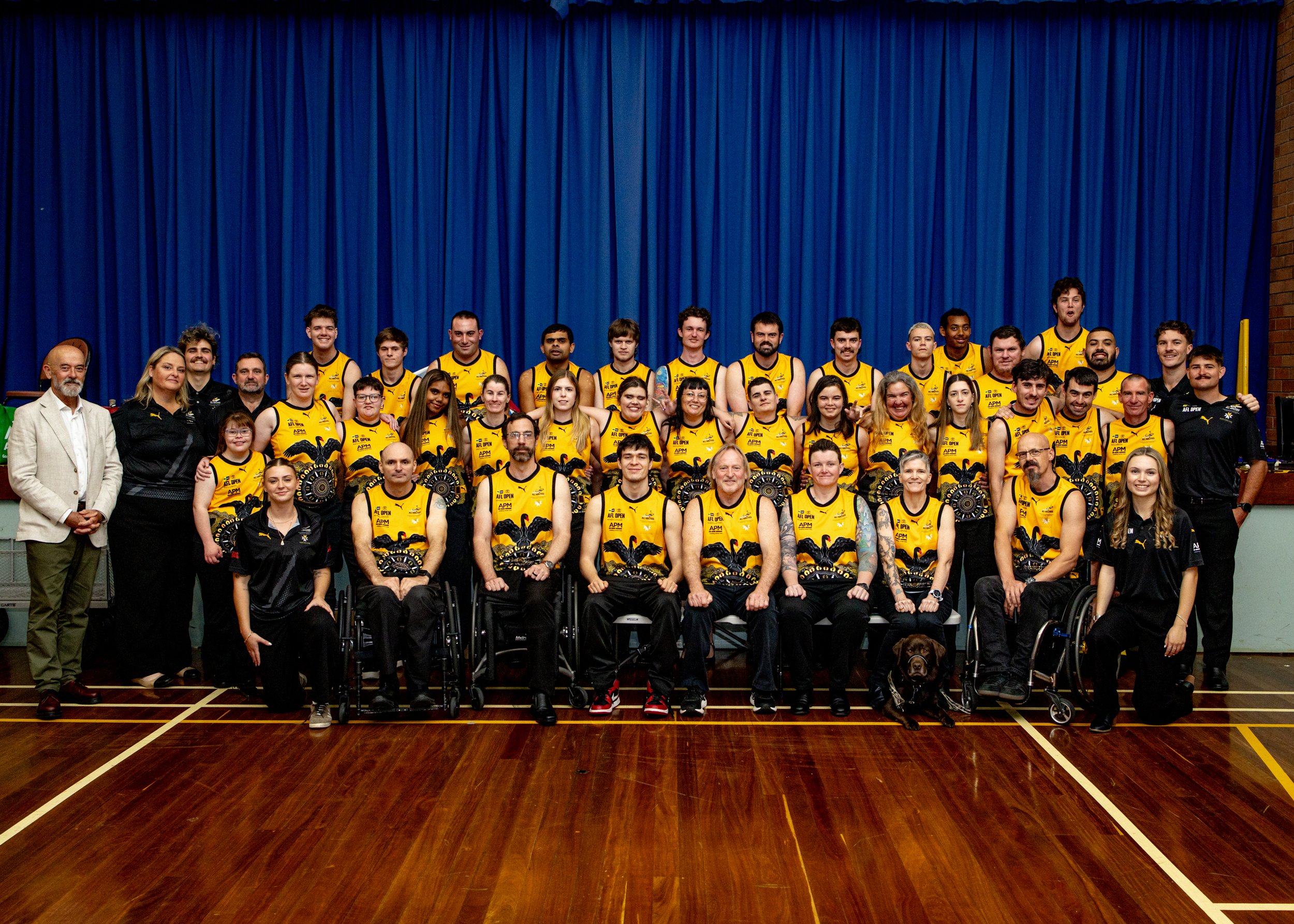
APM Men’s, Women’s, and Wheelchair teams, and supporting staff at jumper presentations.
Photo: Kiara Blake - @sidlelinestills_bykiarablake
Of these 40 players, three represented Blind Sports WA and would be participating in the first state-level blind football exhibition match. The 12 women would be the first women in WA’s inclusion football history to participate in a state-level competition. Of the 16 male players, some had competed in almost every AFL Open carnival, while others would be participating in their first ever. The Wheelchair team, made up of nine players, two of whom we would meet in Melbourne, would be participating in the 10th year of wheelchair football.
The opening day had shown what all three teams were capable of, the APM Men’s and Wheelchair teams winning 3 of 4 games, and the women’s side having a clean winning sweep of both games. But as the carnival continued, the fight became about more than winning games.
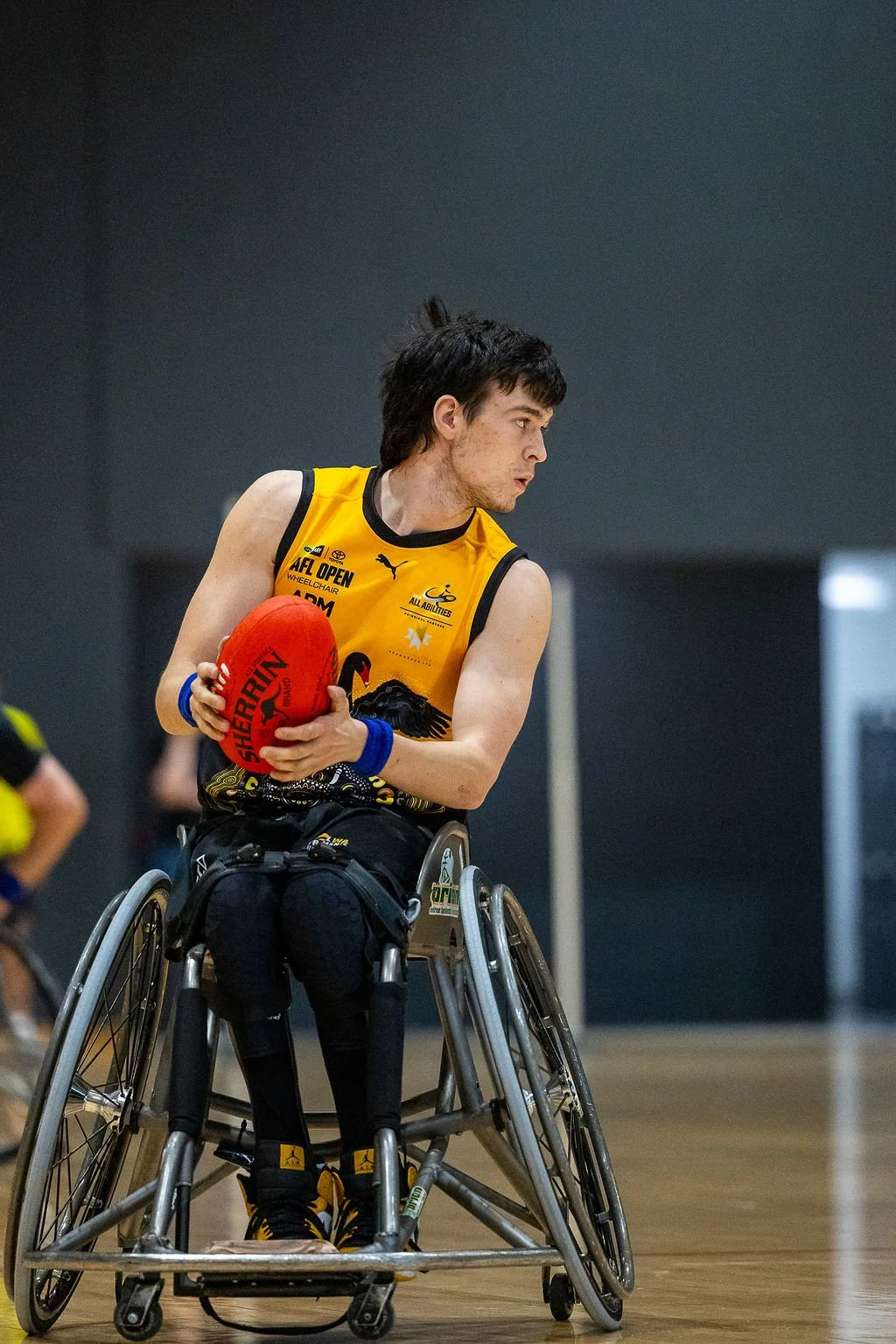
Jordan Mouritz. Photo: Ann Lord - @annlordphotography
One unforgettable moment came in the game against RSL, when the APM Wheelchair team worked the full court in just 15 seconds with three handballs, Jordan Mouritz pinching the win with a final handball after the siren, as Ryan Zilioli and Rob Petersen reflected. The result helped secure WA’s Division 1 place, with the team also standing as the only Division 1 side with female representation.
Paul Whitehurst said in an interview to 7News Regional, “it’s not something I thought I’d ever get to do, it’s just unreal… It’s been great pulling on the Black and Gold for WA.”
For the men, the loss against South Australia on the second day was devastating. After putting in so much work throughout the year, the result hit hard. A significant portion of the team was left in tears.
“It just hurt so much to lose after putting in so much work,” player Alex Moshovis reflected.
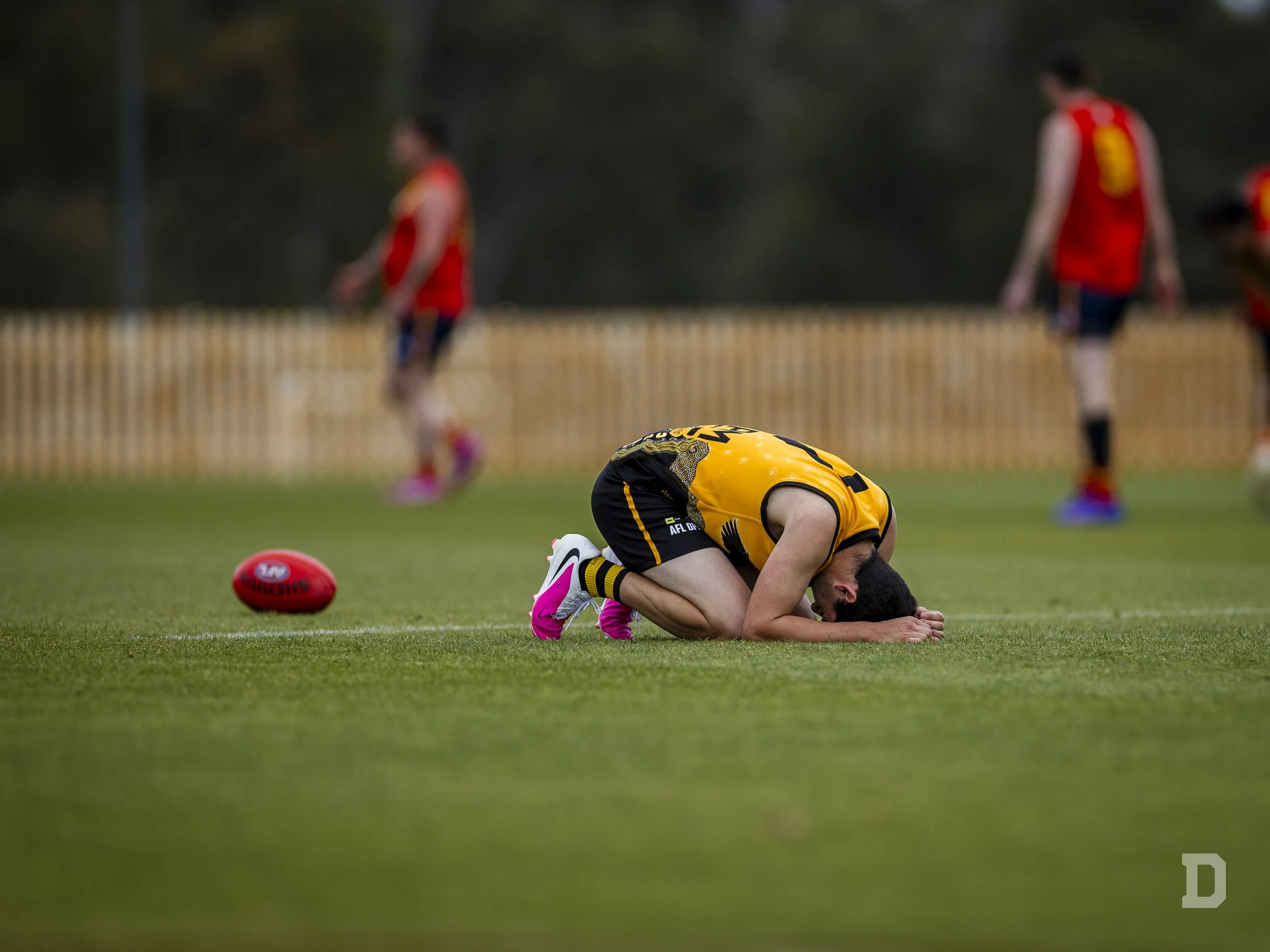
Alex Moshovis, moments after losing to South Australia on day two. Photo: Michael Lovell - @desolveimages
From the coaching bench, there were plenty of mixed emotions, but the most heavily felt was pride.
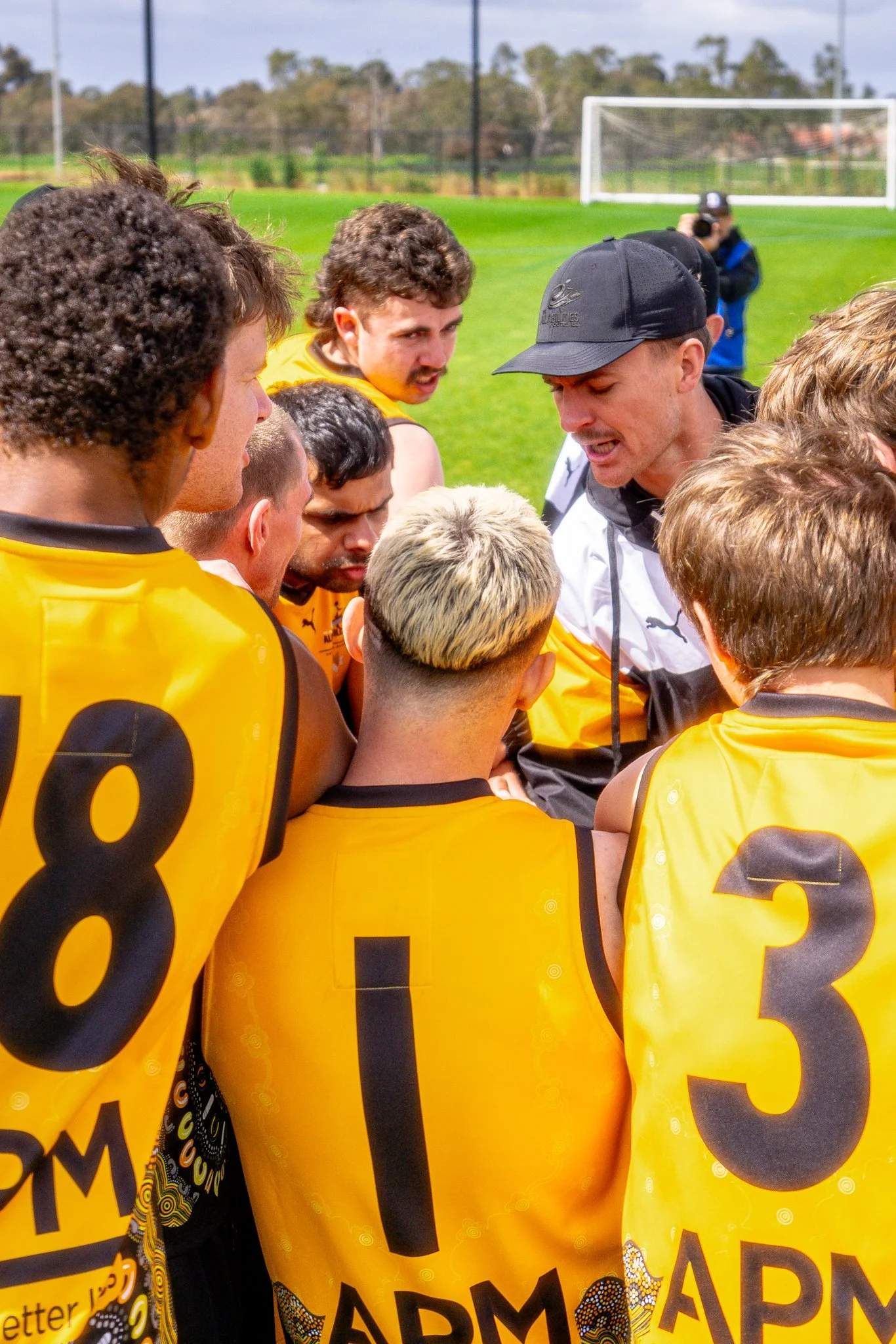
Coach Tom Medhat in the team huddle. Photo: Duc Thai - @duc_photo
“We were in a really strong position after a fantastic performance against Tasmania earlier in the day… As coaches, it was genuinely emotional to watch. There were moments where it was hard to hold back tears of pride, because even when the game was well beyond reach, their spirit never wavered. Our assistant coach Justin Prior summed it up perfectly after the game: ‘If anyone was to ask me what WA spirit looks like, I would tell them to watch the replay of this game and the way our boys never gave in.’ I don't think I've ever been prouder of a group of players after a loss.”
Both the APM Men’s Inclusion and Wheelchair teams had put in the work this year. They had prepared, trained and competed with everything they had, and while they didn’t get the results they wanted, the fight they showed was never in question.
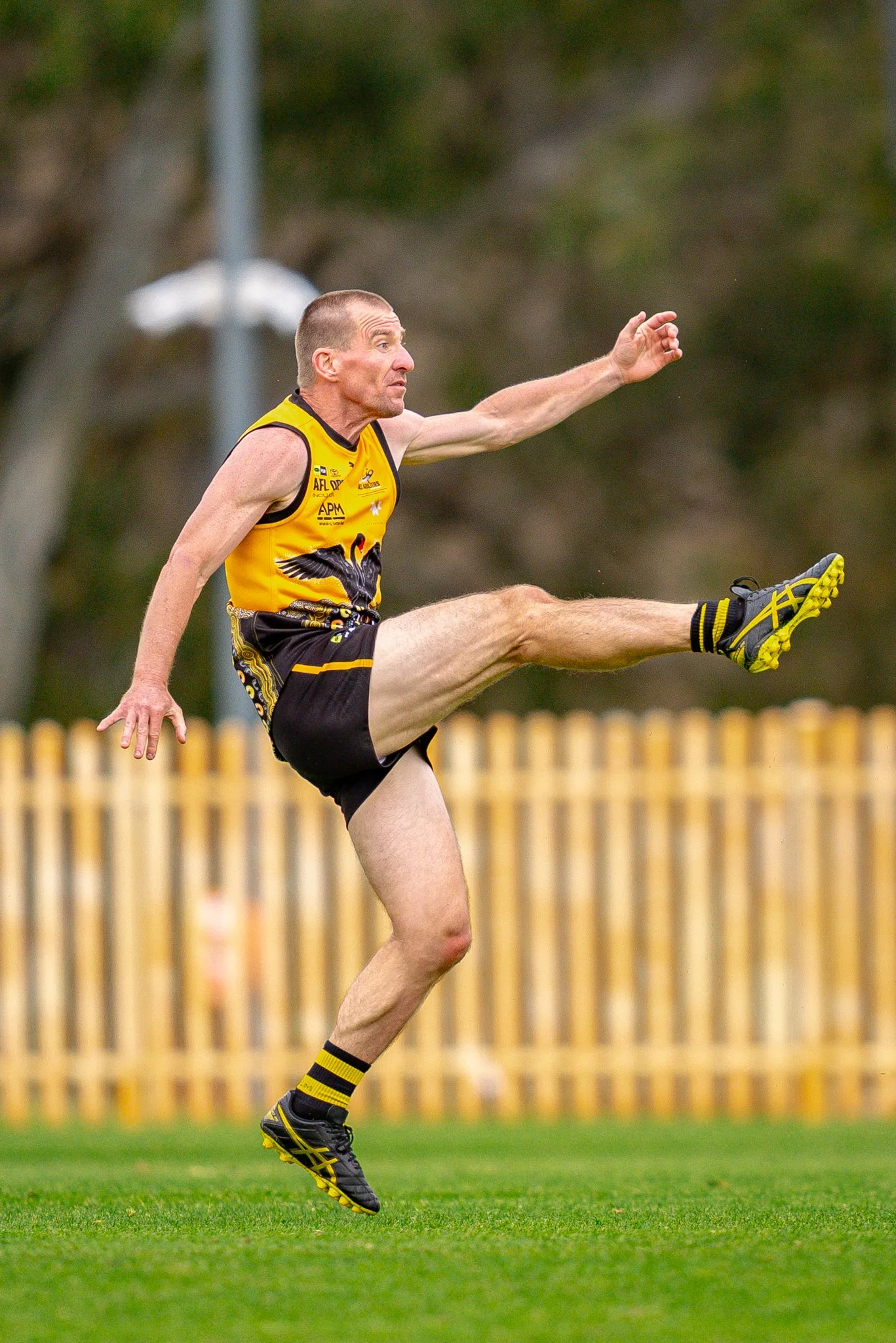
Lyndsey Ashworth - Duc Thai @duc_photo
The losses were made even harder by the injuries the teams endured throughout the carnival. By the end of the second day, we had lost two players to the bench: Lynsey Ashworth, with two broken ribs, and Reece McIntyre, with a dislocated finger.
During the staff debrief that night, reflecting on Ashworth and McIntyre’s past carnivals, the consensus was that they were players who never complained, never slowed down and kept going, no matter how hard they played.
“I don’t think he’s ever complained to me about anything,” said Tyson Wright, a three-time WA physio, speaking about Ashworth. “So, the fact he came off the field telling me he was hurting, I knew there was definitely something wrong.”
Reece had been a leader throughout the season, speaking on behalf of men’s captain Fraser Kickett during team pep talks and post-game addresses with the opposition. After a nasty collision between the ball and his finger, we knew Reece was out for the rest of the carnival.
But he never fully stepped away from the game.
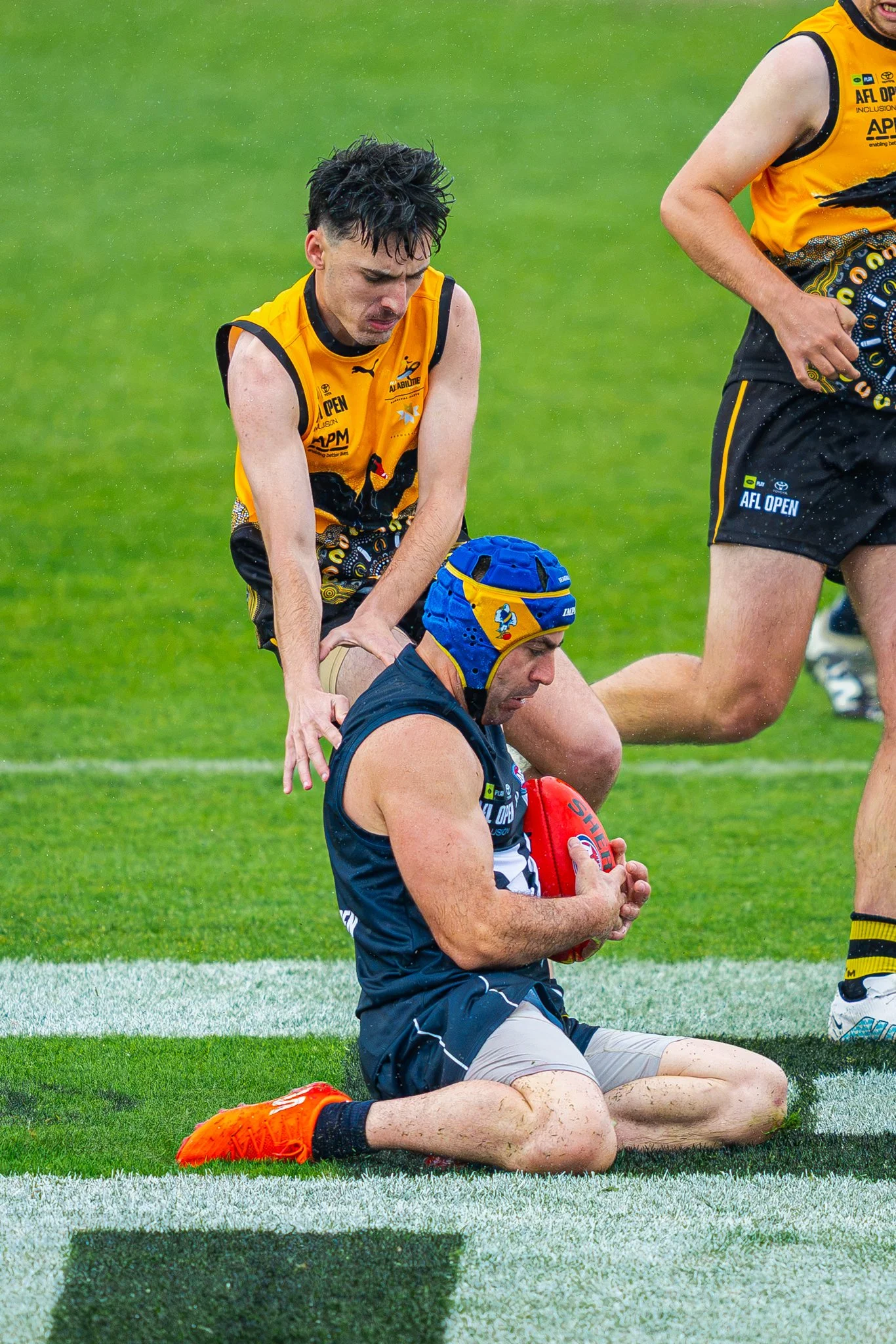
Reece McIntyre. Photo: Duc Thai - @duc_photo
After spending most of that Tuesday evening in the hospital with Lynsey, Tyson and WAAAFA Executive Officer Hayden Marchetto, Reece showed up bright and early for the third place division final against Tasmania. Instead of putting on his boots, he put on his coaching hat, helping his teammates through their final game.
“I want smiles and enjoyment. That’s all I want you boys to do, alright?”
Reece’s mum, Raquel, reached out after the carnival:
“This level of football has gifted Reece a much deeper sense of belonging and purpose with like-minded young men and women, and what he’s trying to achieve goes far beyond the game. What WA did in Melbourne, the way you all showed up for one another, was the most incredible experience to witness this year! Watching this all unfold has been an experience as parents and spectators that we will never forget, and we are so grateful Reece has incredible role models in his world.”
Our three blind representatives, Ben Rowe, Alan Leahy, and Darren Stevens, were the first ever blind players from WA to participate in a state level game of football. With players from South Australia, and Victoria, “I think it was great to meet other players,” said Ben Rowe, Player and Blind Sports WA Executive Officer.
“Dragon, Reuben, and Jackson were great, and it was good to share in something we were all passionate about. I think the whole experience of having blind AFL to showcase to others and put the sport on the map that it is a sport that’s available – you never know who’s watching, and seeing the fun, participation, and enjoyment, and that means a lot… Having the other teams come down and support us was great, being a part of the team… there was a group synergy, they had a collective identity.”
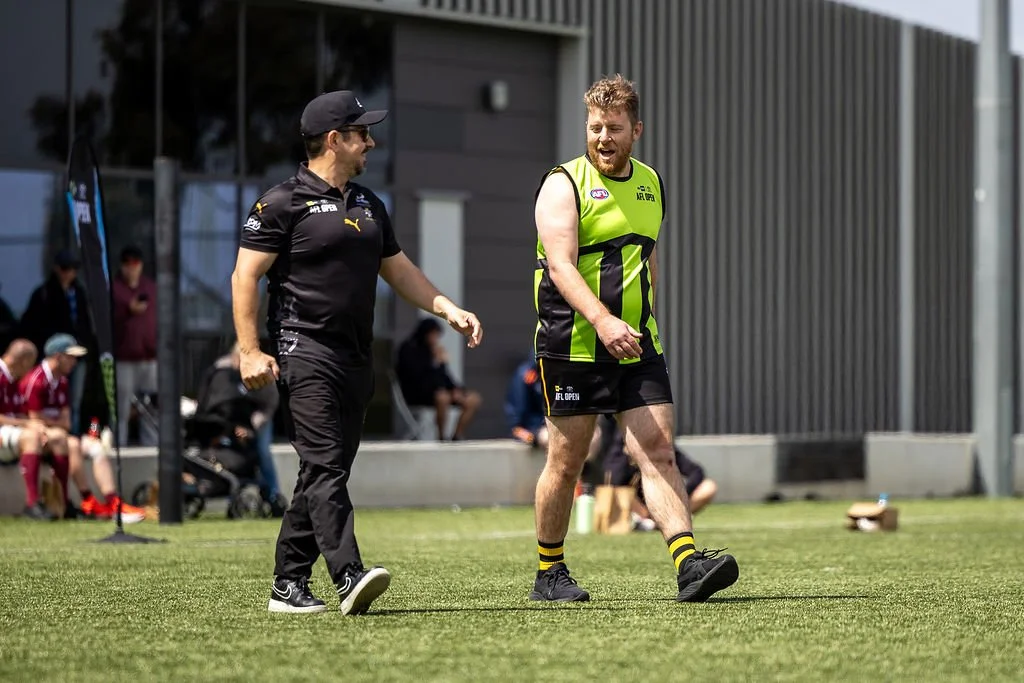
Blind Sports WA representative, Claudio Fabiano (left) and Ben Rowe (right) during the Blind AFL Showcase game. Photo: Ann Lord - @annlordphotography
“I love the game,” was the first bit of feedback I had from Darren. “But I love the part of it where you had to step up. [In Perth] it’s very inclusive, which is fantastic, but playing at a state level was really cool. Getting to meet other players and see how they go about it and have the same sort of passion for it.”
Darren, as a player, has always been known to throw himself into the game 100%, and by the end of the showcase, came off with bleeding knees, and elbows, blood splattered on his jumper, and the biggest grin I’ve seen from an injured player. Men’s assistant coach, Justin Prior, after watching Darren throw himself in front of the ball for a smother that was so loud, and clean, it threatened to break to sound barrier, he said watching him was “the best thing he’s ever seen.”
Physio Tyson, upon seeing the state of Darren after the game, could not believe the physicality of Blind football.
There’s a mountain of these moments I could recall, small individual stories the showcase how much this trip meant to each and every player, staff member, parent and friend. I could have walked you through the entire carnival, a play by play of every win and every loss, but when reflecting on the impact of this trip, there is only one moment that encompasses it all.
We stood on the fat side of the oval, just beneath Kayo’s streaming cameras and commentary box. If you ever want to hear the roar of WA, the footage of the women’s grand final is still up on Kayo, where, behind the commentary, you can hear the rest of the WA side cheering on the women.
Some of the men’s players, who had previously been relatively reserved throughout the trip, were particularly invested in the game. David Hallows, for example, had made an effort to be on his best behaviour this trip. It was Callum Bull who turned to David in the final quarter and said, “You can let loose now.”
And that he did.
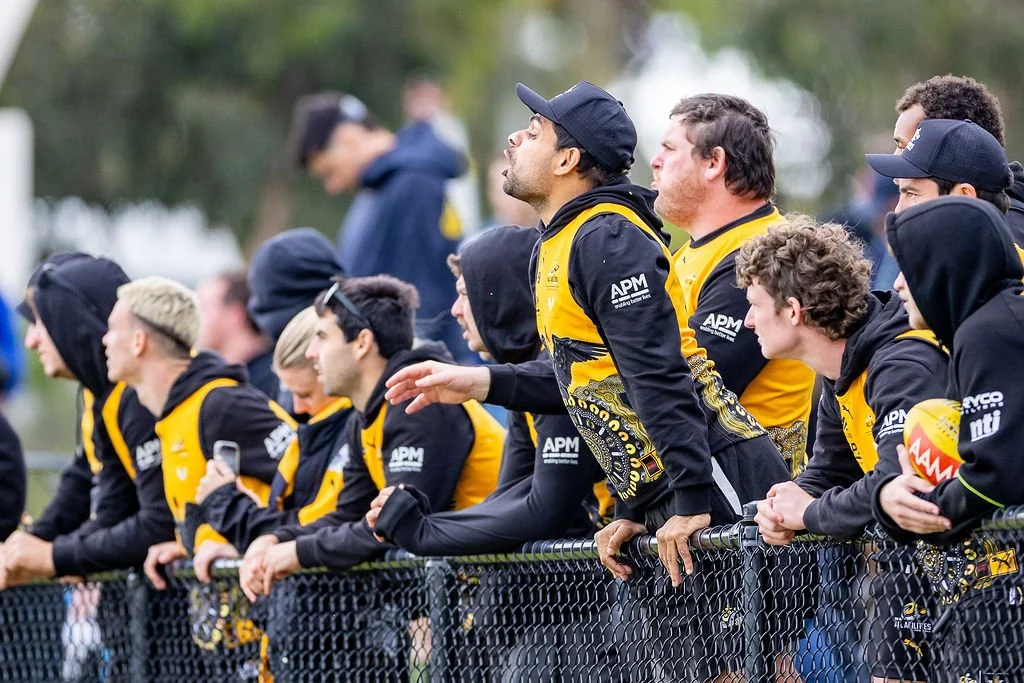
The WA Roar, the Men’s inclusion team cheering on the women. In focus, APM Men’s iunclusion captain, Fraser Kickett, to his left, David Hallows. Photo: Ann Lord @annlordphotography
The side-lines were a chorus of passionate match commentary, but it wasn’t the usual criticism of the umpires’ calls that you would expect to hear. It was profound support for the women’s team.
We were celebrating the small wins: a good handball out of congestion, a solid kick out of the middle, or a tackle deep into the back line, which we can’t talk about without acknowledging Payton Haslam for some solid backline pressure.
An onlooker would never suspect these players had just lost their second division third place final, the final loss of the carnival, both the APM Wheelchair and Men’s team finishing fourth overall. Especially when the defeat against South Australia the day before had been so devastating to the men’s side that a good percentage of the team was in tears.
Yet there they were, standing on the side-lines, pouring everything they had into supporting the women’s side.
We were a minute and a half out from the final siren when the possibility of a premiership became real, and we raced around to the open gates to be there when the girls won. The eagerness to get out there was palpable, each of us pressing at the boundary, while we held each other back. I distinctly remember Callum Bull, the unusual voice of reason, “Don’t go out too early, we don’t want the umpires to call against them.”
We were two points ahead. The Allies had a set shot on goal, and the hearts of WA were in their throats. The kick missed, with the ball going out on the full. Abbey Partridge, number 3, picked it up and handed it off to number 11, Michelle Lowe.
Then the siren went.
If you were watching from home, you would have seen Michelle Lowe throw the ball to the ground in shock. But what you missed was the accumulation of the WA spirit spilling out onto the oval.
With no hesitation, we burst through the gate and sprinted onto the oval the second the WA APM Women’s team officially claimed the inaugural premiership for the state women’s competition.
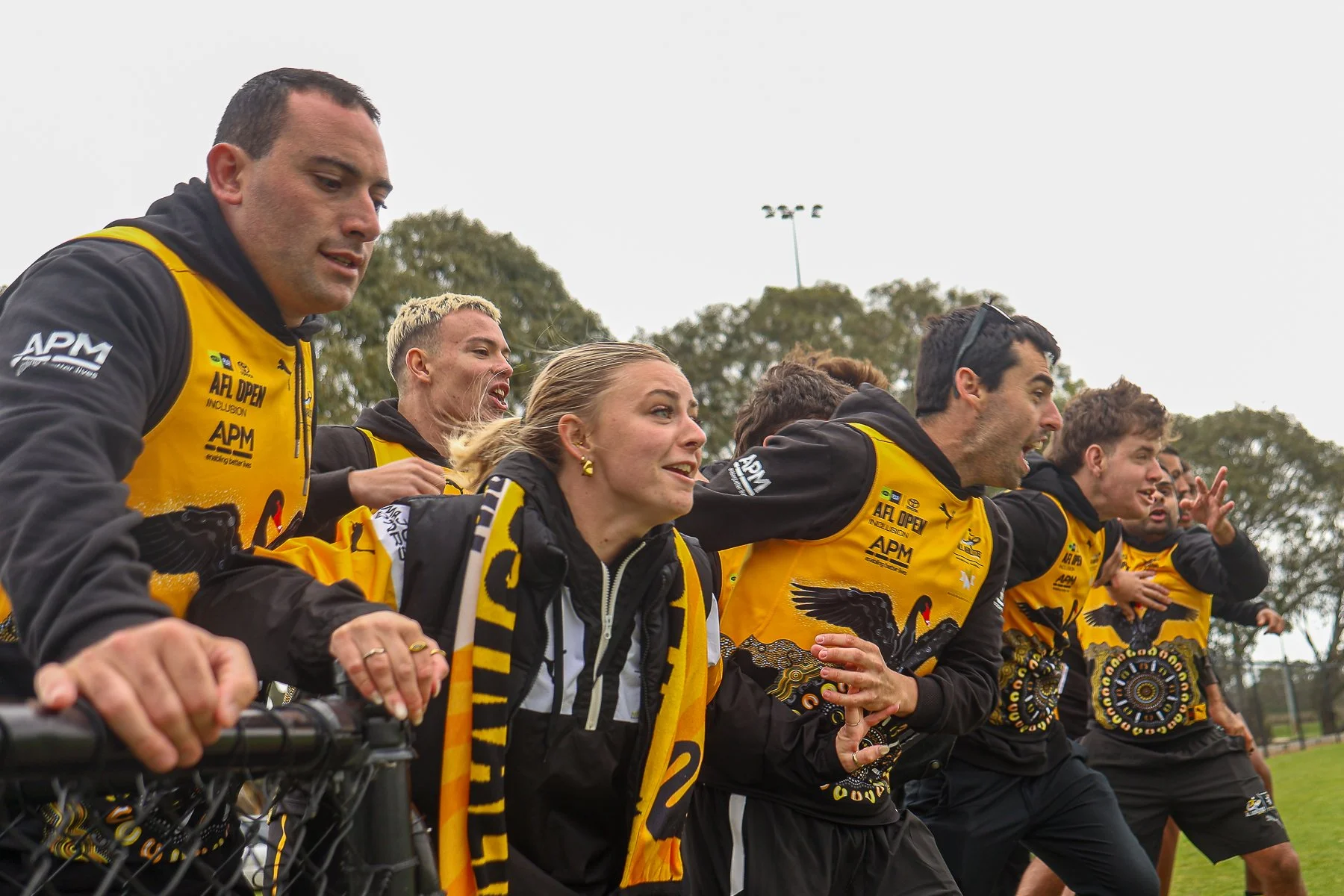
APM Men’s Inclusion players running out onto the oval the second the final siren went. Photo: Dylan Buckley @thedilmaphotographer
Even after three days of football, with tired and sore legs, they met the women’s team in the middle of the oval in a matter of seconds. Later, Coach Tom had laughed and said, “I wish they’d run that hard during games.”
There was no distinction between teams, no thought about who had won or lost their own games. There was just WA.
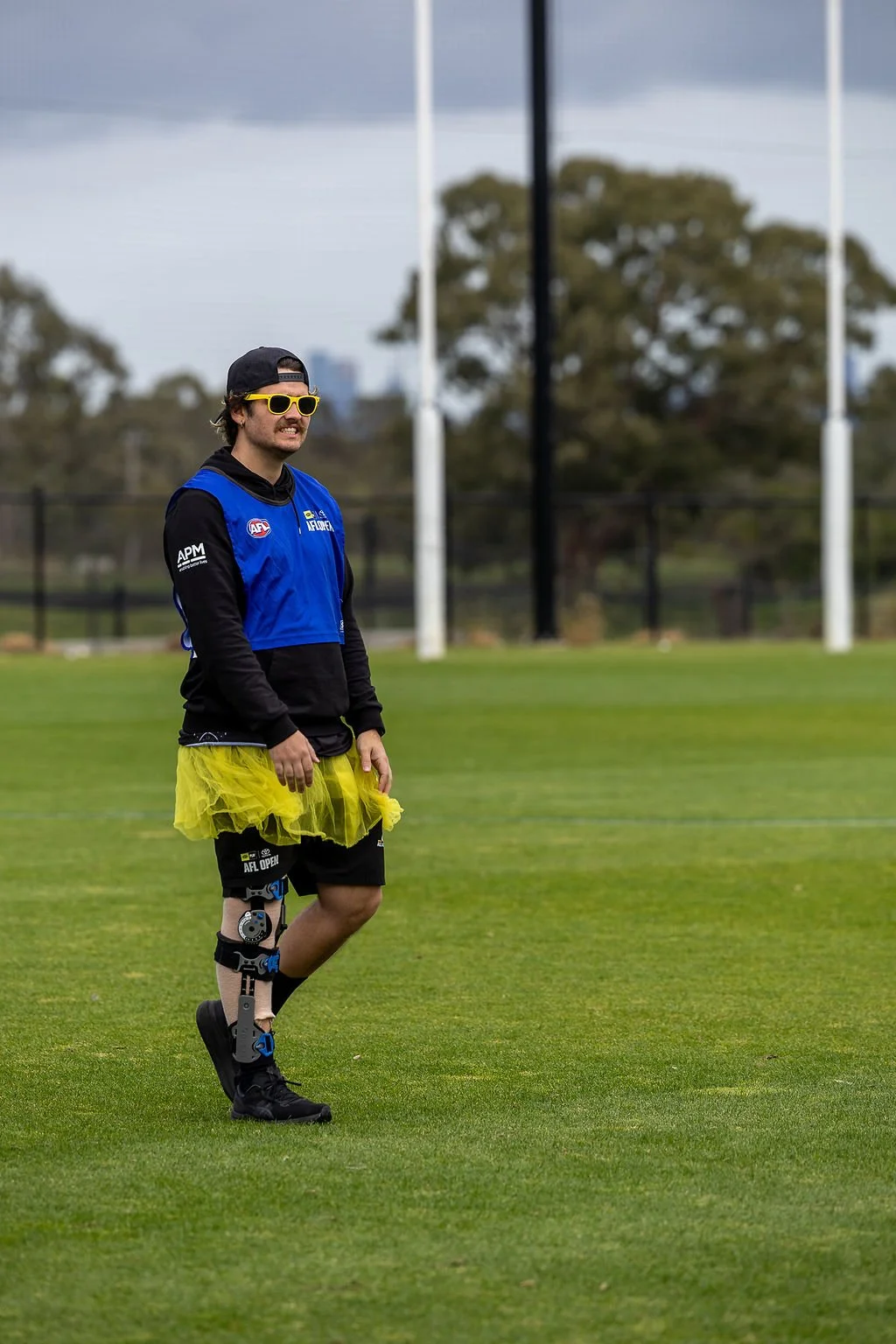
Charlie Cronin. Photo: Ann Lord - @annlordphotography
Charlie Cronin, a WA All Abilities staff member, and All Australian “Brick Wall” from the 2025 AFL Open, returned in 2026 as a supporting coach and staff member.
“As a past player, I know what it’s like to be able to go out there and have fun, but this year, being a coach, that emphasised for me how important it was to make sure that the players had fun, and to be okay expressing themselves, like wearing tutu’s when supporting the other teams.”
“Watching them do that… I think one of the only words I can use to describe it is pride… It was such a bittersweet moment for the boys, because this is the first time WA has won a major league title, so they were so excited for the girls and to be able to celebrate with them, but you could also see how they were disappointed after the loss the day before.”
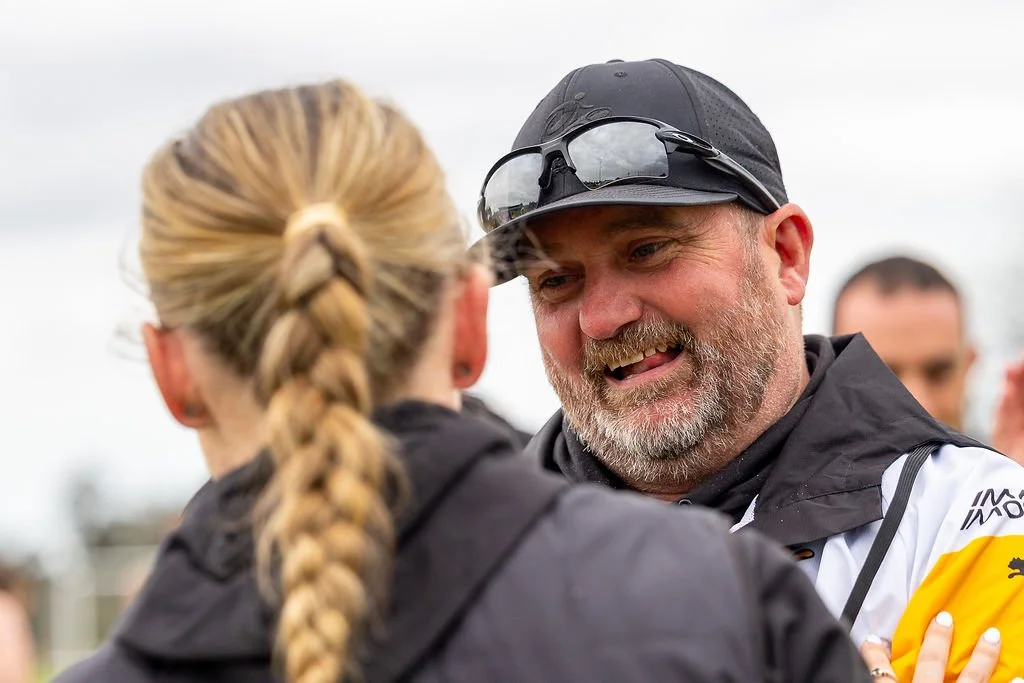
David Wright & Andrea Petersen after the win. Photo: Ann Lord @annlordphotography
“It didn’t matter who was who in the zoo,” women’s coach David “Wrighty” Wright reflected on the phone to me a few days after we arrived back in Perth. “It didn’t matter if you were running the show, or if you were running water. It didn’t matter which part you fitted into; the elation was still the same.”
There aren’t enough words to describe how it felt to be on Oval 2 at La Trobe University that day. The celebrations from all WA teams extended far beyond a normal premiership win.
For the first time ever, these women had competed at a state level, something the men’s and wheelchair teams had been doing for years, and they had won.
But this moment was about more than a premiership. It was about the Integrated community we have built in WA, with football being the vehicle for something much bigger, whether that be community, friendship or family. You can see that when we show up at a state level.
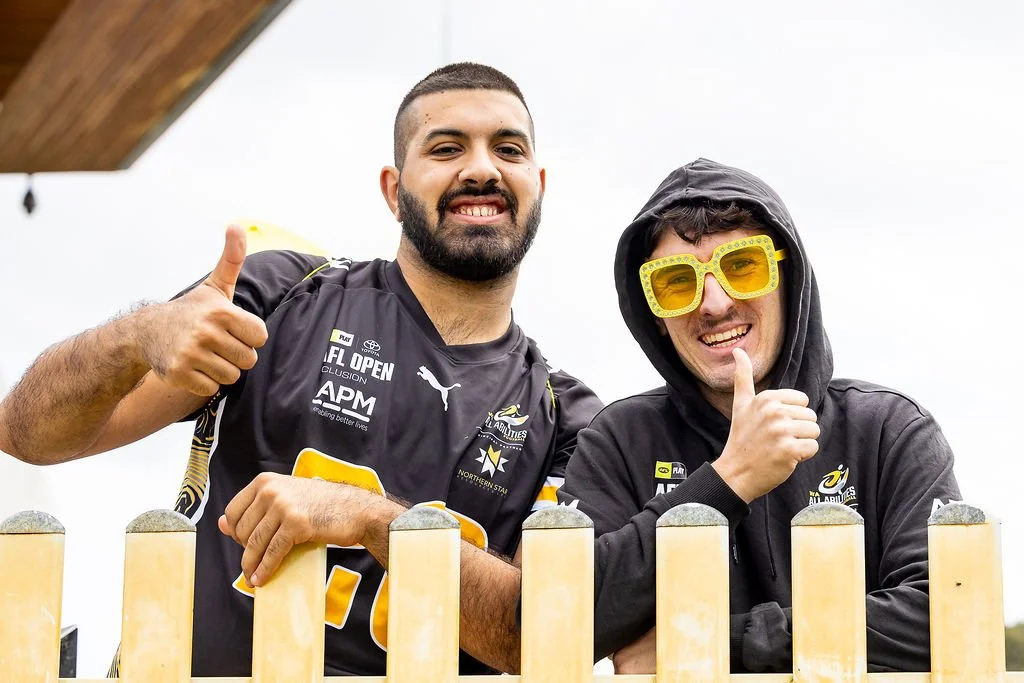
Zachary Aquino & Reece McIntyre. Photo: Ann Lord @annlordphotography
Wrighty shared a story about people from Victoria who had come down to watch and support the women in the grand final. “One woman was talking to me about how unified WA was,” he recalled. “She was blown away by the way we supported each other, and she said, ‘We want to become like that.’” It was a powerful reflection of what had unfolded on the oval, every player, regardless of their result, had a place in that moment.
WA has spent the year building the women’s inclusion football space, with the She Can Play program holding its first-ever competition season. The competition featured two teams, one at Canning Vale Football Club and the other at Kingsway Football Club.
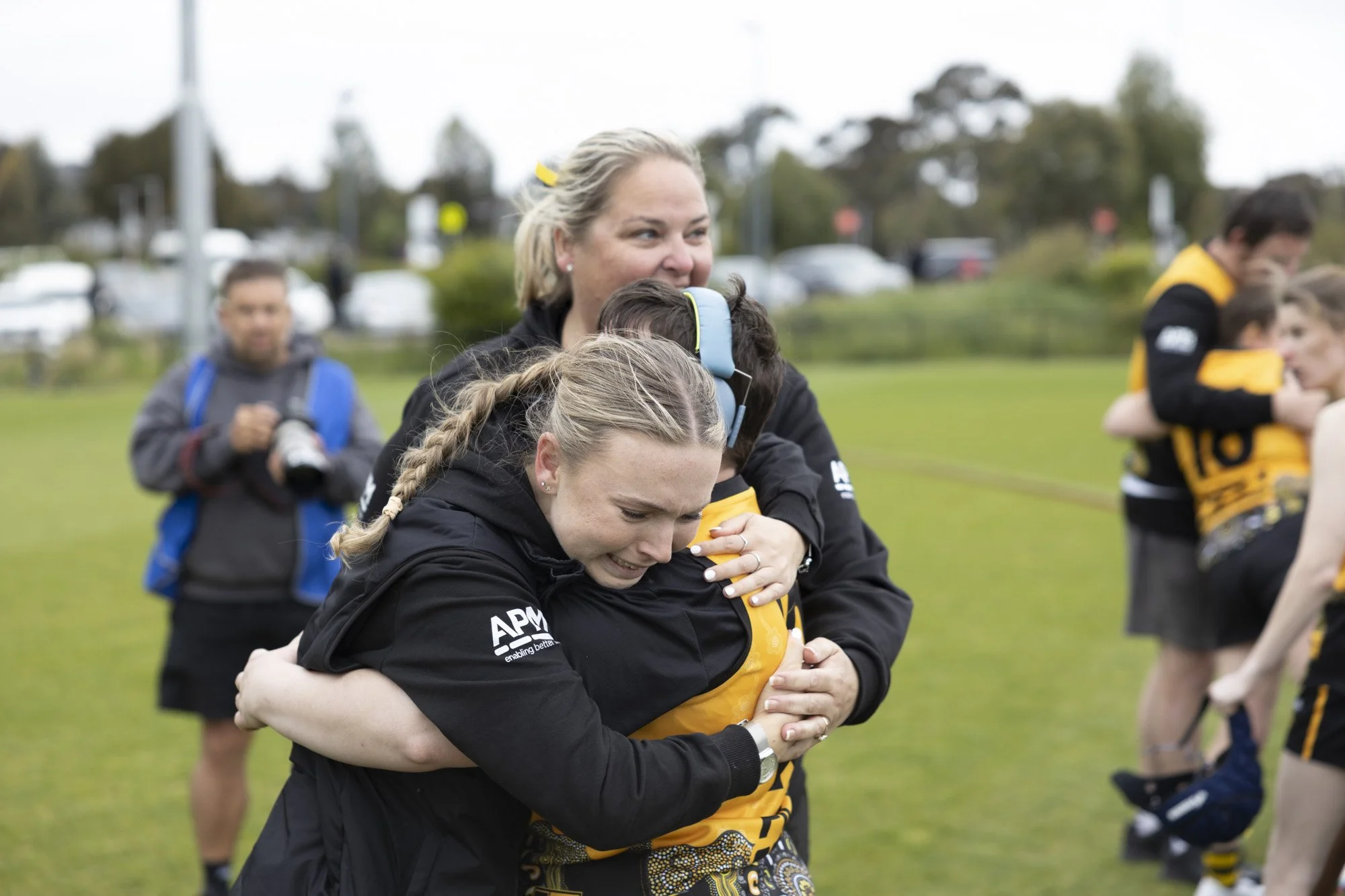
Andrea Peterson and Payton Haslam. Photo: Jim Gorman @jamesgormanphotography
Assistant coach and Women’s team manager, Andrea Petersen, said: “It’s been great to see the girls grow and gain friendships, confidence, and community with the She Can Play program and Inclusion Football Academy. Being able to take a women’s team to Melbourne and see them run out on the La Trobe grounds as a collective, it was awesome to see how far the women’s football space has grown.”
Most of these women played in this competition, but they all had an array of different football journeys.
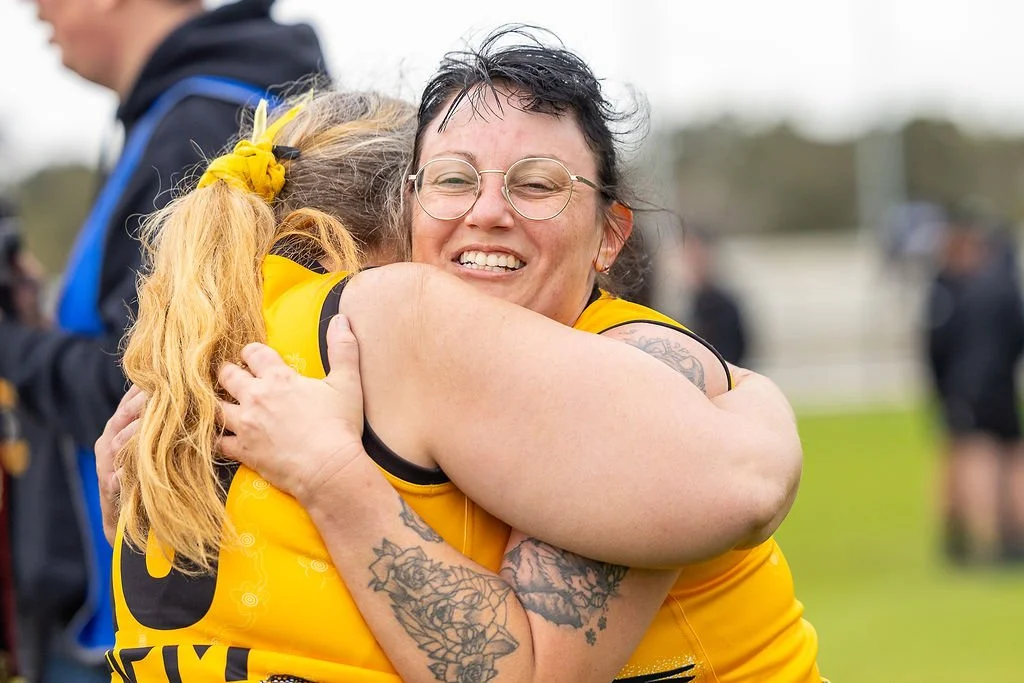
Kellee Thomas (left) & Michelle Lowe (right) after the win. Photo: Ann Lord @annlordphotography
Michelle Lowe and Kellee Thomas already played at Kingsway in the mixed Integrated competition, whereas this was Faith Pascoe’s first year of playing AFL ever, and joined the Kingsway She Can Play team with no football experience.
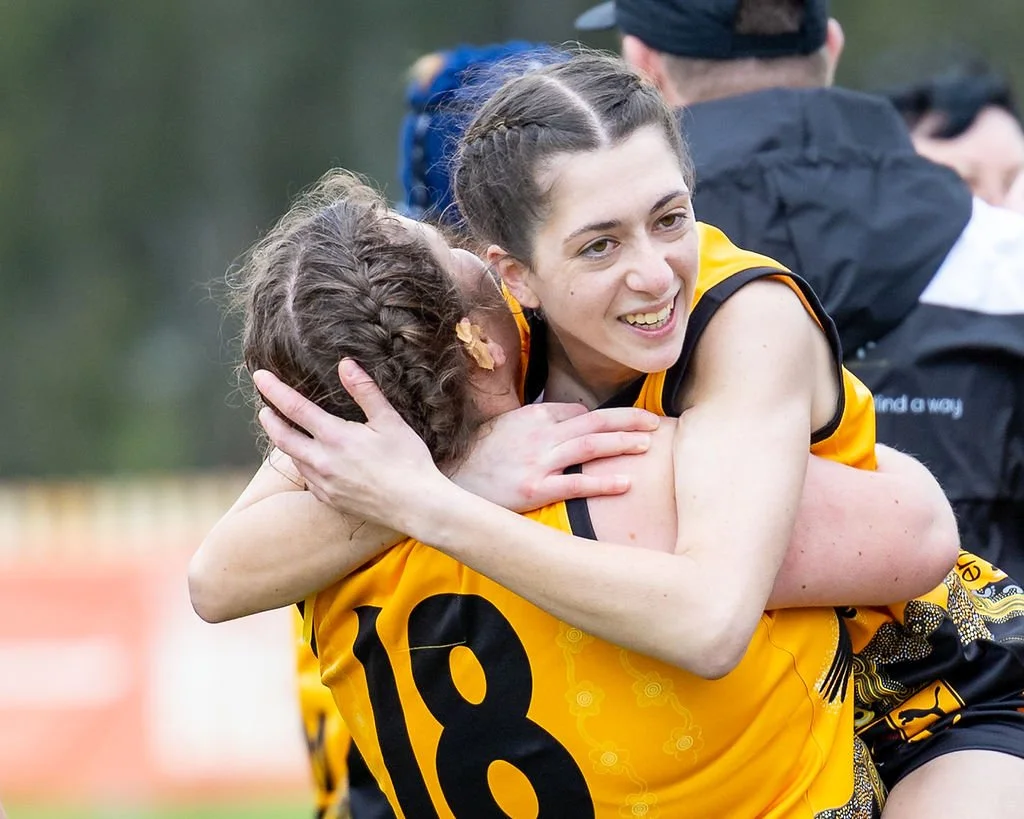
Abbey Partridge (right), Eliza Bain (left). Photo: Ann Lord @annlordphotography
Abbey Partridge, a Kingsway player, taking out the club’s Fairest and Best title for the women’s side in 2025, and took out a sweep of awards at the Open, getting Best on Ground, Best and Fairest, and All Australian for the 2026 AFL Open. “Living with chronic migraines and ADHD has it’s challenges, especially when it comes to footy, and I had a pretty disappointing season this year because of it… So, I feel pretty grateful and privileged to have been a part of this experience. It really reminded me that it’s more than just a game... footy has the ability to bring people together, and create a space where everyone belongs.”
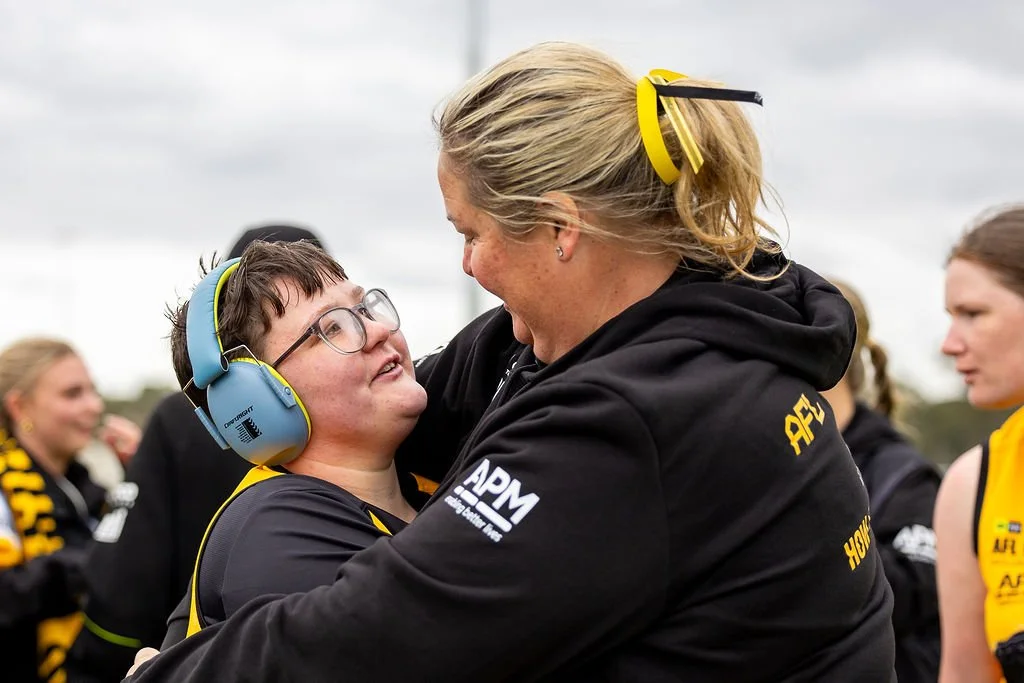
Payton Haslam (left) & Sue Briggs (right) - Photo: Ann Lord (@annlordphotography)
Payton Haslam, who plays for Kelmscott and Canning Vale She Can Play, in a message to the women’s group chat hours after returning to Perth said; “This team has helped me know I can ask for help from more then just my family and wife. I can’t explain how much this means to me. You’ve given me confidence on and off the field and I’m so grateful for that.”
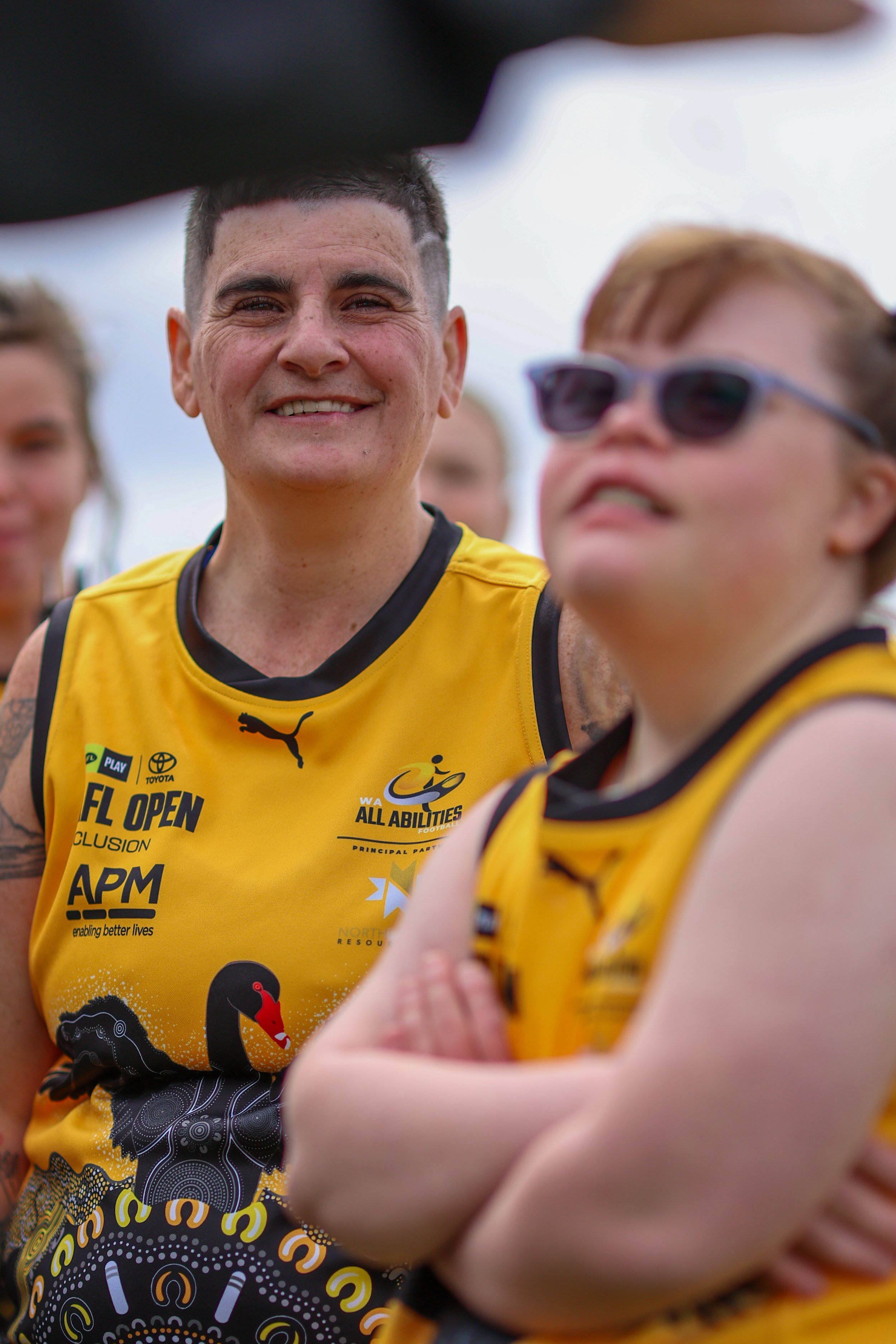
Tracy Toms (left, focused) & Faith Pascoe (right, unfocused). Photo: Eddie Guerrero - @eddie.gphotography
Tracy Toms, the state team’s vice-captain, not only played in Canning Vale’s She Can Play team, but is also the captain of High Wycombe’s mixed Integrated team. Her support worker, Julie Campbell, said in an interview during state training the previous month; “Tomsie loves it, it’s given her purpose. She can give back to people, and she is giving back. She’s mentoring and helping other to become the best version of themselves… She’s doing things women can do without men around, and having like-mined, strong-willed females around her too.”
Karis Abbott from the Ellenbrook Dockers’ Youth Integrated team, only 14, kicked WA’s only goal in the grand final, and was named All Australian for 2026. Her Parents, Ash and Jen Abbott, were moved to say the least. “We saw growth and confidence in Karis as both a footballer and as a person, and to see her interact with the other girls (All of whom are significantly older than her) and make friendships that will last into the future was just amazing. Everyday Karis experienced the support and encouragement of the girls in her side, the boys side and the coaches and support staff from WA… it showed her that there are other people similar to her with their own little “bumps in road” that can enjoy coming together and have fun playing football… As a family it was one of those experiences that we will never forget, to see your daughter supported and encouraged by so many people, for us to meet and get closer and have conversations with the girls and boys sides as well as the coaches and support staff was inspiring and I would say that it felt like we all were “one big family”.
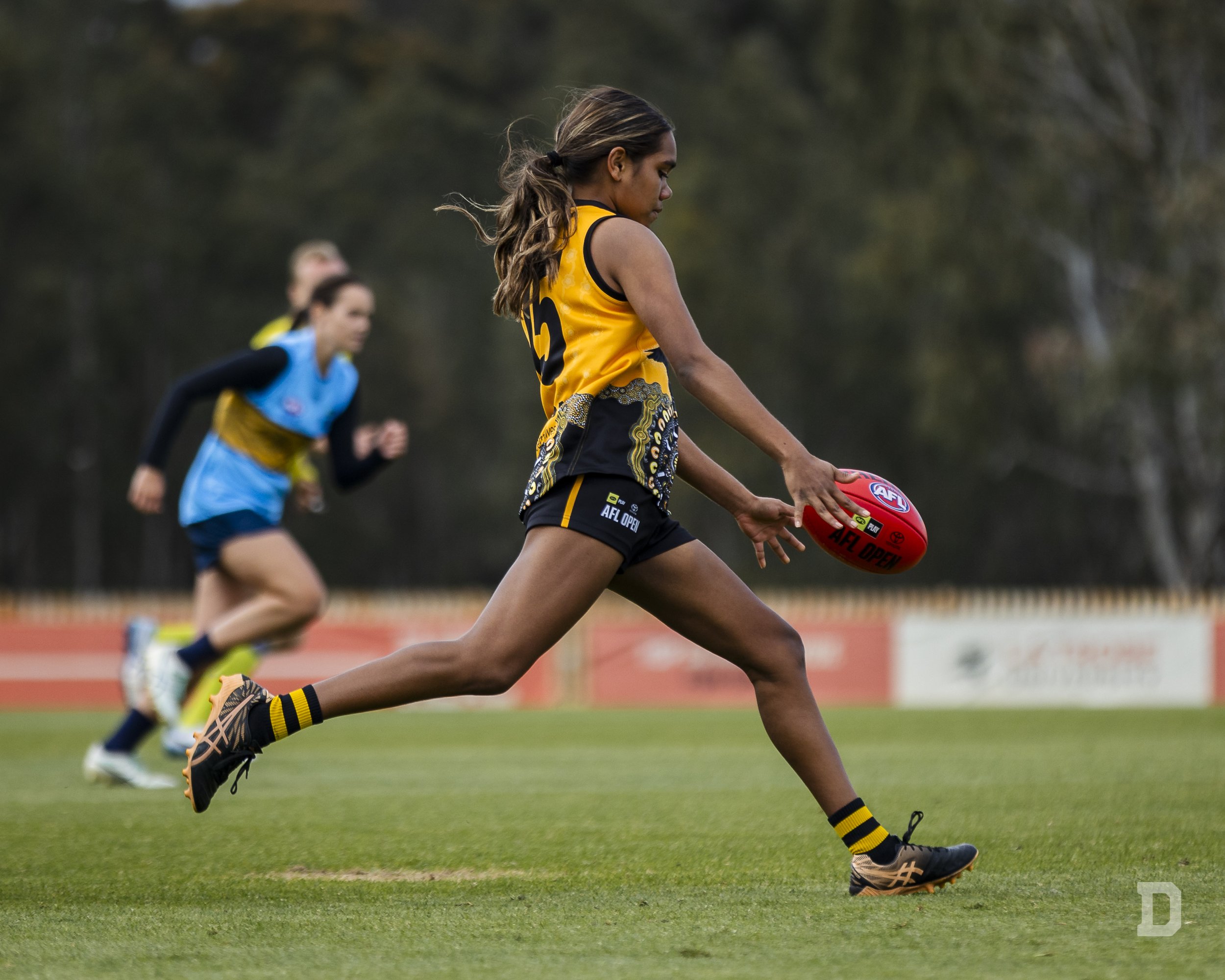
Karis Abbott (14). Photo: Michael Lovell - @desolveimages
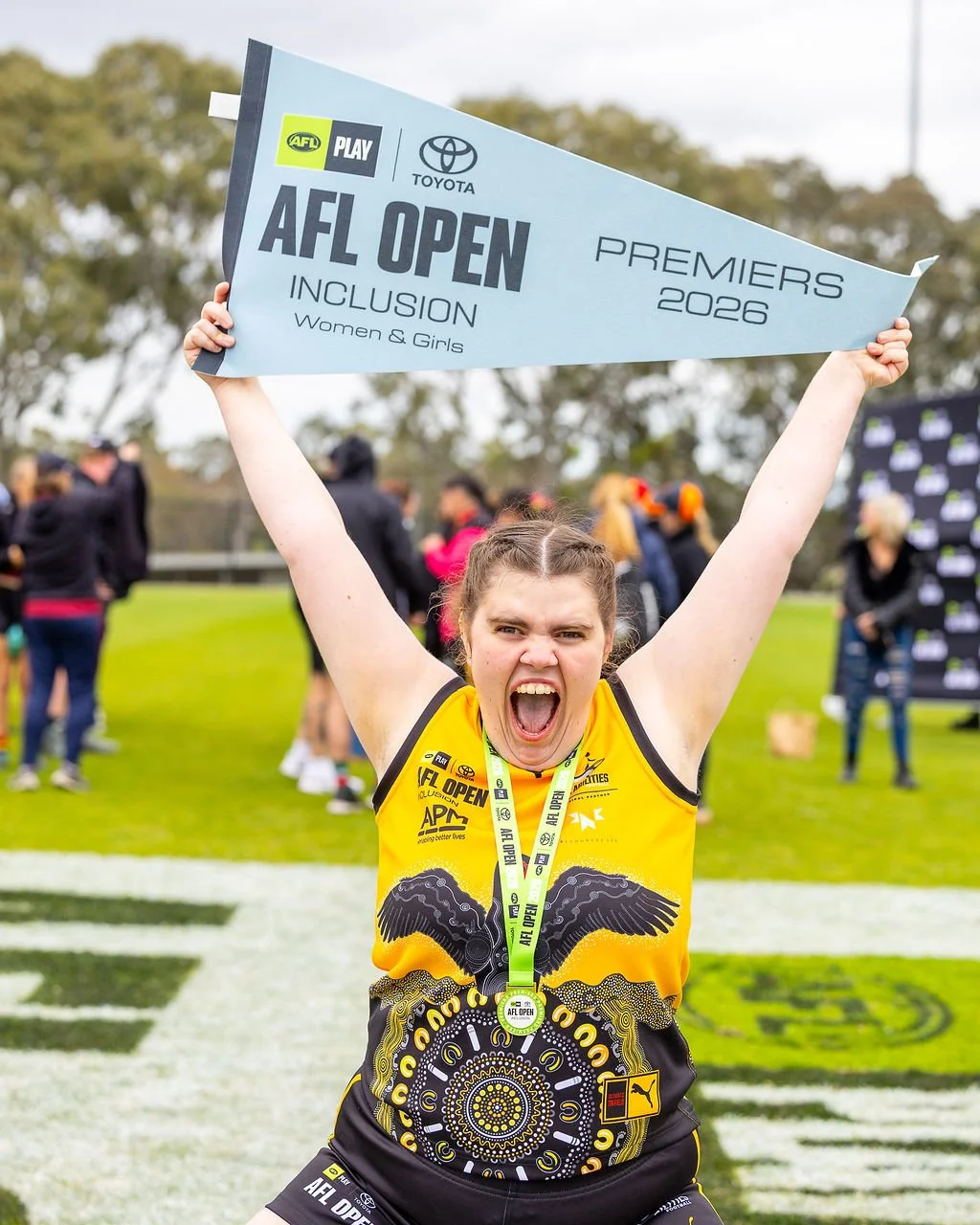
Captain Eliza Bain with the inaugural Women’s Inclusion Premiership flag. Photo: Ann Lord - @annlordphotography
Eliza Bain, playing for both Kelmscott mixed integrated and Canning Vale She Can Play, the captain of the APM Women’s Inclusion team, said in her captain’s speech; “We are now the first women’s team to compete in a full carnival. How amazing does that feel? We are breaking barriers in girls footy and we are absolutely nailing it… I love seeing how supportive, caring, and encouraging we are as a team… We also have shown everyone how much girls football means to us. We are breaking barriers, making history, building friendships and proving that girls belong out on the field just as much as anyone else… And honestly, how good is footy?”
Different journeys had brought these women together, and on that Wednesday afternoon, they had made history. There was no end to the celebrations on the field, or a dry eye. And it wasn’t hard to understand why.
It has now been over a week since the WA teams returned home to Perth, and the love for the carnival on socials has not ended. Posts from AFL Play, the AFL and AFLW, various photographers, staff and players have continued to reflect on the experience.
The love for these players and the game has flooded our social networks, and we at WAAAFA could not be prouder of the community that surrounds us and our players.
One caption from AFL Play reads, “Because footy is for everyone.”
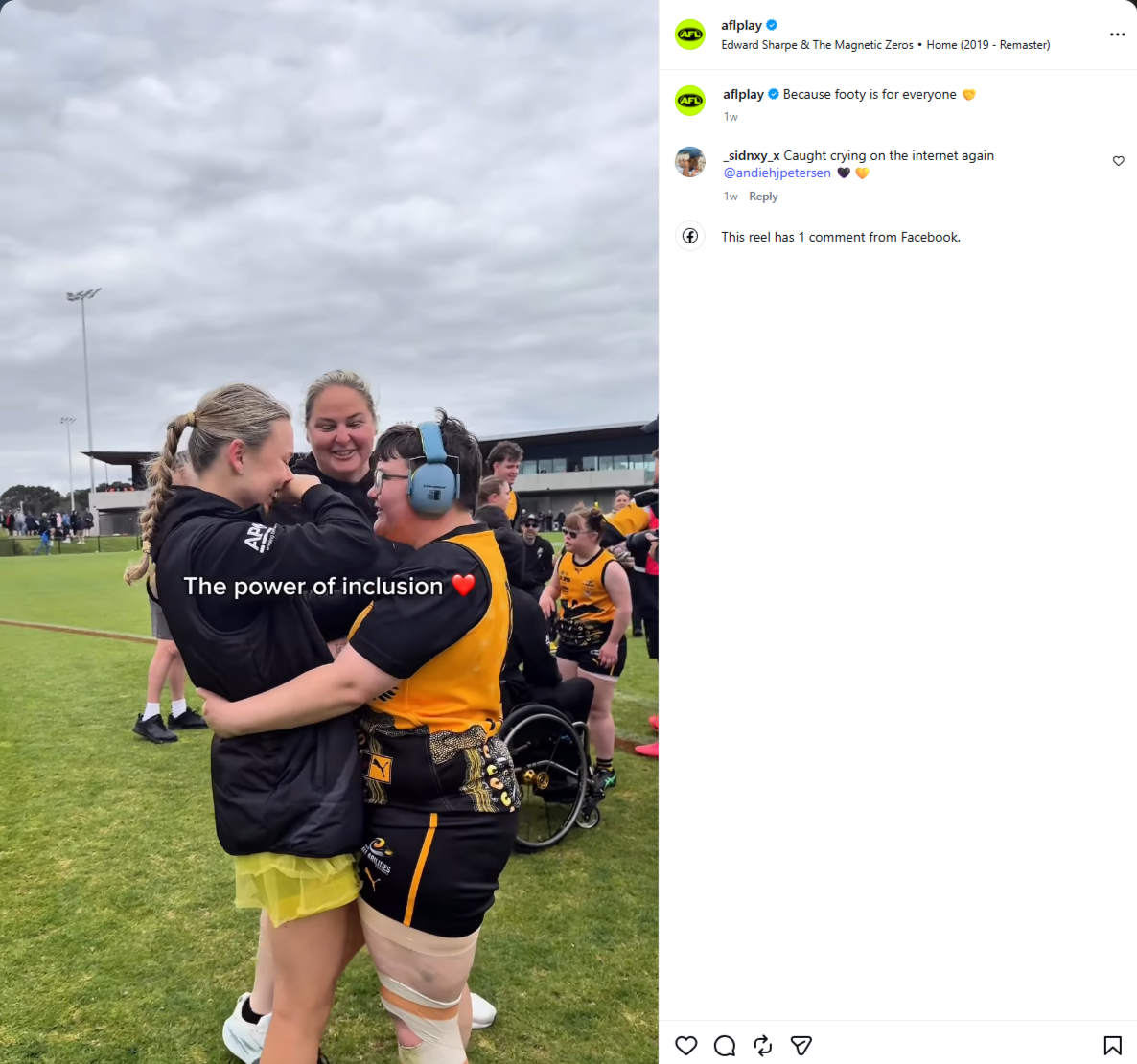
2026 will be remembered as a milestone year for inclusion football. From the first state-level blind football exhibition match, to the women making history with their inaugural premiership, and the determination shown by the men’s and wheelchair teams, the carnival gave us plenty to celebrate.
But what stands out most is what happened beyond the results. The way players supported one another through the highs and lows, the pride they carried in representing WA, and the connections that continued to grow throughout and after the trip.
As Men’s Coach Tom reflected: “The skill, spirit and performances on the field were incredibly special, but what stands out most to me is what this experience meant to the players beyond football. To see the resilience they showed throughout the carnival, the way they supported each other through the highs and lows, and the genuine connection and friendships they built along the way was something really special. This was a group of people who genuinely cared about each other, and I think that showed in everything they did, both on and off the field. As a coach, there's nothing more rewarding than seeing a group come together like that, and it's something I'll remember for a long time.”
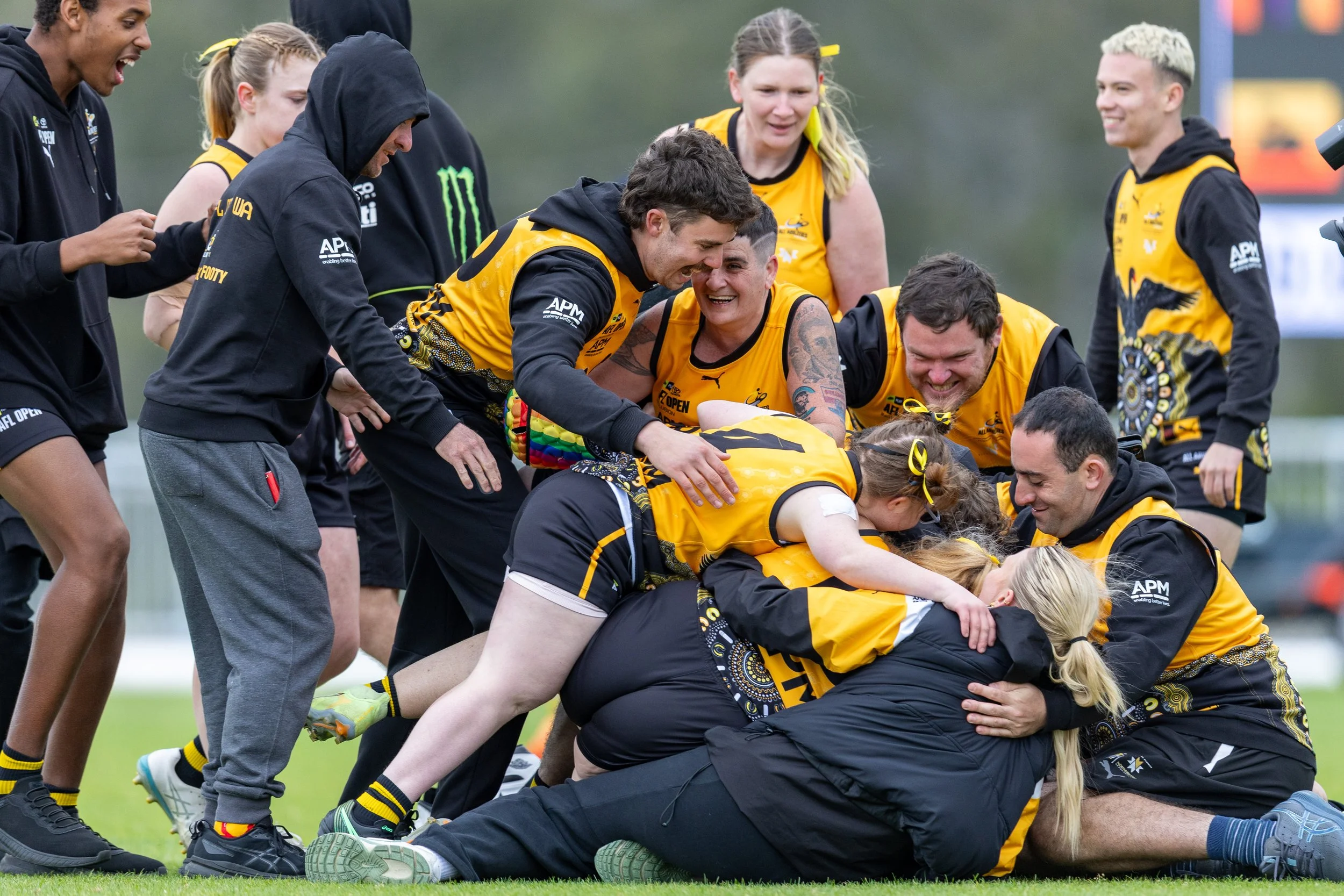
Celebrating the win, Men’s and Women’s inclusion teams. Photo: Kate O’Brien - @hall.of.frame.images.studio
We travelled to Melbourne as different teams, each with our own goals, challenges and stories. We returned with memories and achievements that will stay with us for years to come, but perhaps most importantly, with a reminder of what makes WA’s inclusion football community so special.
And that’s something we’ll be celebrating long after the final siren.